About Me

My photo
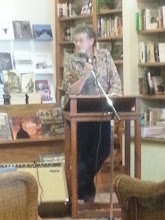
Poet, essayist, teacher, Sarah Webb co-edits the magazine JustThis with Kim Mosley and Emma Skogstad. JustThis explores the Zen arts. Sarah was Poetry and Fiction editor for twelve years for Crosstimbers, the multicultural interdisciplinary journal of the University of Science and Arts of Oklahoma.

Wednesday, October 23, 2013


“I share the belief of many of my contemporaries that the spiritual crisis pervading all spheres of Western industrial society can be remedied only by a change in our world view. We shall have to shift from the materialistic, dualistic belief that people and their environment are separate, toward a new consciousness of an all-encompassing reality, which embraces the experiencing ego, a reality in which people feel their oneness with animate nature and all of creation.”   —Dr. Albert Hoffman
quoted from Parabola newsletter Dec. 9, 2011

While I think that it is not just environment we are separate from (try other people, for just one thing), I do strongly agree with Dr. Hoffman that our culture has gone astray in a fundamental way.  My trips are my fumbling attempt to find a way back to oneness--with the world I experience as I travel through plains and mountains and with the people I meet.  And through silence and simplification, with whatever comes.
We have followed the materialist, dualistic road so far as a culture that we are in terrible trouble.  I do not know what will happen as the world heats up.  We will change, whether we want to or not.  For me, my response to the crisis is to look toward the root, the separation we feel.  Others, with a different bent, may respond with political or scientific solutions.  Seeing our difficulty as a sickness of the soul, I am responding by addressing the soul.

Thursday, July 18, 2013

The Ancients (from the journals)


I wrote this up from my journals today as I am putting together my book.

 
2009 6-12            The Ancients

           A little fly dances to my nose
            and out of reach.
            My arm follows up and out.
            I return to my sitting.

            I was tired and slow that day.  I poked around camp until noon, knowing I’d be staying over.  When I went out I followed a portion of the Falls Trail, my body aching. The trail took me by gray ant nests, huge ones.  Walking toward me, a woman grinned.  I puzzled over her smile as I hiked until I realized why.  It was my tee shirt.  I was wearing one of my favorites, black with white petroglyphs all over.  Mixed with the usual petroglyphs of goats and thunderbirds were  a space saucer and Mickey Mouse and a jackalope and who knows what else.
            When I got back I sat in the shade to write.  A fly pestered me.  He piggybacked on my hand as I wrote, then danced around my shirt.  After a while I lay down my journal and straightened my back to meditate.  The fly returned.
            I went up to the Visitor’s Center--I  was at Bandelier National Monument--and sat in an outdoor courtyard.  Ravens were talking, herk, herk, awp.  I saw a feather or twig drop from them, but when I went over, it wasn't there.  Raven trick.
            My doctor had told me about Bandelier, said it was his favorite place to go.  He and I share an interest in American Indian art and ancient sites, so I thought I’d give it a try.  I understood why he liked it when I went out to the cliff houses that afternoon.  From the trail I could see many dark openings, some natural, some clearly made by people carving out the tuff (volcanic ash solidified into soft rock).  I saw one cave with a rectangular shape inside.  Depressions, marks, and tiny caves scarred the cliffside.  Higher on the path I could see bigger caves and people climbing into them. 
            It was hard on my knees, but I climbed the many steps to join them.  I was glad when I looked into a room.  It had a fire-blackened, gouged-out ceiling.  I wondered what it would be like to live in the tiny space and to look out into the flood plain below. 
            At the next cave house, bigger and higher on the cliff, I plucked up my courage and climbed to go in.  The ladder was roughly constructed out of logs of cottonwood or pine, steps tied on, and the hands of visitors had polished the wood shiny.  I have a fear of falling and went up fast, not giving myself time to look down.
            Holes riddled the wall in the house, some perhaps for drainage, higher ones to let out smoke.  The room was round, blackened above with soot, cream-colored near the floor.  A pictograph covered a part of the wall, almost obscured by flaking and smoke. Its dark zigzag circled an arc of the room in a fluid and messy movement, as if it had been applied with a large brush.  The zigzag ended in a more complex painting, perhaps the face of a man with a headband and stylized feather.  It had been painted more thickly and precisely in a colored plaster.  The feather image was white, and where hair might be, black.  The “face” was red and a side bar red, and the features or interior details black and white.
            The space was appealing.  It was bigger than the earlier room, with a window, an alcove depression where things could be set, and a ledge for a fire.  I stuck my hand up where the smoke would go, and found a flue.  I wondered how far the flue would have to reach to let the smoke escape.  Logs with hook-shaped stubs had been plunged into the wall, places to hang baskets and things like clothing (I read the people at Bandelier wove cloaks of turkey feathers).  It was very satisfying to stand there, to imagine living there.  It probably was the size of my camper-bus inside, slightly bigger, and round, of course.  All the stuff you needed to live would be near to hand--food and blankets and weapons and your place to cook. And you could look out at the landscape. Not so different than the bus.
            My breath tightened as I looked down the ladder polished by so many hands and feet.  The ground seemed far below.  But others were waiting to come up, so I turned and fumbled with my foot for the first log. A step, a step, I told myself, and moved methodically down, holding my terror at bay.
            I lingered at two grottos where sunlight filtered between the cliffs down into slender cottonwoods, and a soft moisture filled the air.  The path didn’t enter the small refuges; too many feet would destroy the , I imagine.  They seemed cool and leafy and mysterious.
            Below the cliffs, I walked among the adobe-brick houses, some built in front of cave houses, apparently to extend their space. Lower yet were partially fallen houses and nearer the stream, the ruins of others.  A circle of ruined rooms surrounded a kiva.
            Before I left Bandelier I walked a long way down Fry Trail and felt the landscape.  The walk was hard on my back and legs, but I was strengthening.  I saw two mule deer and a black beetle being eaten by red beetles.
            I wonder what the appeal is for me of American Indian ruins and petroglyphs.  Despite some family stories of Creek or Cherokee blood, I have no kin ties.  I did enjoy my time teaching the Kiowa tribe and learning about them, and I have friends from several tribes.  Really, though, I think the draw is something else.  The art that I see on the stones and walls, the simpler lifestyle, living in the land, those are things I want in my own life--art, simplification, oneness with the world around me.  They are all things that come from my traveling too.  Not the community the cliff dwellers had, though. 
            When I traveled to Ireland and Scotland, it was the ancients who intrigued me--the carvings of spirals and rings and cups, the barrows, the stone circles.  And when I taught linguistics I would have spent weeks if I could have on the roots of Indo-European.  What were the words that revealed their lives?  Spirit was shining, bear was taboo to name, no original word for wheel but words for salmon and beech and apple.  And the earliest words yet, before Indoeuropean, 13,000 years or more--I and nose, father and mother, sun and moon.
            When I go on the road to lead a simpler life, I’m not looking for austerity or self denial.  Simplifying is not wanting things and not getting them; it’s turning to what is most essential.  
Sunday, July 14, 2013

I'm writing these posts from journals I've kept the last six summers as I've traveled the West, just me and my dog, mostly in my VW camper-bus, though this year I went in my Toyota van with seats replaced with a narrow bed and storage.  Mostly I'm going to post things that are happening now.  I think.

One thing that is happening now is that I am writing up the old journal entries and turning them into a book.  Two books, the first with a little dog named Missy I picked up on the road and the second, with my big hound dog Rex as a companion.  I'm getting close to the end of book #1, which I hope to call 55 mph (because that's the speed I drove my Vanagon at).  I am ginning up to computerize the drawings too.  When I can, I'll post some of them too. New ones may have to wait until I'm home. 


rodeo memory (from the journals)

an earlier trip memory, when I went through a town I'd been a rodeo photographer at some years before:
Rodeo Memory
            I remember, from back when my ex and I were rodeo photographers, sitting on the fence at a rodeo in Bend, Oregon.  Ropers had gone all evening the night before and from 6 that morning.  But now we had the show part of the rodeo with the bulls and the clowns and the announcer cracking jokes over the staticky PA system, things like, “he’s kicking everything but the tail feathers”  And then they played the national anthem and we all stood, cowboys with hats over hearts.  I stood up from my railing, lifted three inches maybe. 
            The announcer said, “Let’s all take a moment of silence for those poor folks over in Portland.” 
            Which gave me an odd feeling.  For a week hippies and protestors had been converging on Portland.  I don’t remember now the issue, though probably the war, and there was going to be a city-wide demonstration.  The police had geared up--flak vests, tear gas, the whole business, and the paper shrilled that the country was menaced by these Communist sympathizers.  But, shoot, I knew at least six people who were planning to march.  They had some long hair, yes, and ragged jeans, but not a violent bone among them.
            Still, I bowed my head with the rest. 
            At that moment, I knew we were playacting, my husband and I.  We weren’t ranch folk, we didn’t even descend from the ranch, like the city welders and truck stop garagemen who came to the rodeos on the coast, looking for a life they had lost with their childhood.
            But I guess it didn’t matter.  We were all playacting in a way, making our temporary town of cowboys and stockmen, saying we hadn’t lost the farm, hadn’t turned into an office worker or a restaurant waitress--or wouldn’t like our Mom and Dad had.  For a while we had a chance to make the old way live, and we did.

Women Who Feed Crows

Women Who Feed Crows
I am going to put some entries in from my trips across the West.  Today's entry happened yesterday, but I may put some older ones in too.  I'm visiting friends in the Northwest. 


2013  7-13  
            I walked down to the elementary school playground, where I could let Rex off lead.  Usually he makes one circuit of the playground and then goes back to the gate.  If there is a dog to play with we might go two.  He uses the bathroom and sniffs around the base of the building. Sometimes, like yesterday, he snuffles in the grass and finds something to eat.
            As we walked along the play equipment, a raven croaked at us furiously from the top of the swing set.  I raised my phone to take his picture, which seemed to alarm him further.  He flapped into a tree, continuing his calls.  Another raven joined him. 
            On the other side of the chain link fence, an older woman was kneeling to dig in her garden.  Her small dog stretched onto the fence and barked.  The woman looked up from her lettuce.  “The crows are sure fussing today.”
            I showed her my i phone.  “It’s black and small.  Maybe they think I’ve got a dead raven.”
            She looked doubtful.
            “My dog?”
            “I don’t think so.”   She snapped a lettuce leaf into her basket and added,  “I see them all the time.  They come to my bird feeder.”
            Rex trotted up the handicapped ramp to the school to sniff the entrance, and we continued around the playground.  A woman in a kerchief was sitting at the table on the far side of the playing field.  She didn’t have a dog, but a raven stood near her on the sidewalk.  As we neared, she suddenly stood and, stepping to a section of the grass by the walkway, spread her arms as if blocking passage.  The raven flew up and away.
            Rex ran to her and began snatching something from the grass.  It was the same area he’d found something to eat the day before.  “Go, go!” she shouted at him.  I hurried over.
            “I feed the raven,” she said, as I hauled Rex by his collar.  “Meat in the grass.” Her wide Slavic face was distressed.  “Dog no eat.”
            I fought to clip Rex’s lead. “The ravens?  You feed the ravens meat?”
            She gave a sharp nod.  “Mama ravens need meat for babies.”
            No wonder they’d been fussing, I thought as we left.  Perhaps they had been calling each other to the feast--but they certainly had been warning each other about that interloper dog who gobbled bits they hadn’t found.