About Me

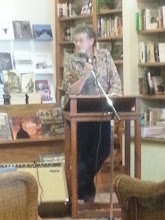
My photo
Poet, essayist, teacher, Sarah Webb co-edits the magazine JustThis with Kim Mosley and Emma Skogstad. JustThis explores the Zen arts. Sarah was Poetry and Fiction editor for twelve years for Crosstimbers, the multicultural interdisciplinary journal of the University of Science and Arts of Oklahoma.

Monday, September 29, 2014

My Friend Ingrid

Note:  I also published this post on my other blog, Sarah Webb.

I had reached Oklahoma and was staying with my daughter.  I had things to attend to--a reading, friends to get together with, the sudden funeral of a poet friend, and--something I had been thinking about all summer--the memorial for my good friend Ingrid Shafer, who died this spring.  The family  asked the college to host her remembrance ceremony since USAO had been Ingrid's community for most of her adult life.

Ingrid was my editor for our college's interdisciplinary journal, Crosstimbers.  I handled the poetry and fiction and helped with whatever she asked me to do, but Ingrid was its heartbeat, as once Cecil Lee had been.  She loved the magazine, the way it brought people together from all over the world, the way it wove disciplines together, the process of creating it--content and sequence and making it into a beautiful object.  It was good to share that ongoing project with her, and we had become much deeper friends as we worked on it together.

I wrote something about her but found myself saying only part of it and other things coming out.  I'll put what I planned to say here, but I think the basic thing about Ingrid was that she saw the world as one. Very few people do that.  For most people the world is divided into you and me or I and it or we and they.  We are separate, atoms that do not join.  Ingrid saw us joined.  I loved her for that and honor her for it.  

From the memorial:

 You may hear people today praising Ingrid Shafer's scholarship, her intelligence—and, yes, she was a brilliant scholar. What I remember most about Ingrid, however, is not her intelligence but her heart.
When Ingrid moved to California to be with her son's family, she took over a little house by the pool and filled it with her books and her bed and her desk and many objects full of memory. It was a little space but mysterious, rich and dark, like her homes in Chickasha. Outside her door under the overhang she set up some plates with food for the birds and for her cat. I had to laugh when she sent me photos of what happened at the feeder—it was the Peaceable Kingdom—skunks ate alongside raccoons and possums and the cat—often at the same time. That was Ingrid. She set up a table and invited everyone in.

When I think about Ingrid, it is hard to find words. She was a person, of course, with her own quirks and interests—her fat dog Shiva and her cats, her delight in the Internet, her love of languages and ideas, the way she'd go without sleep carried on by her enthusiam for a project, her fractals, websites, and poetry. But she was something else too, a force, I'd like to say, though words may play me false here. That force was Oneness. Some might call it love. More than almost anyone I know Ingrid knew we were one—that all people, in different cultures, religions, skin colors, circumstances, are one people. She knew all the world, even past people, was one. And that understanding played out in so many ways.

We saw it in the students who lived in her house, in her patient counseling of anyone who came with a problem, in her faith in students who wanted to change their lives for the better. Given a chance to create courses, what did she create? World Thought, multi-cultural, interdisciplinary. Her childhood horror at the Holocaust—an evil diametrically opposed to oneness—led to work to reduce anti-Semitism. She advocated for interreligious and intercultural dialogue. She worked for a Christianity that is more loving, more flexible, that sees God as unconditional all-embracing universal love .”

Ingrid was a loyal and deeply feeling friend, from her childhood friend, Bernadean, to Andrew Greely with whom she shared a vision of a loving church, to Larry Magrath here at USAO. She and Larry team taught in World Thought together, and students mentioned how their disputes enlivened the class. They discussed ideas out of class too, and wrote together. She organized Larry's memorial after his death, and even in the last year of her life she told me how much she missed him.

I always wanted to be friends with Ingrid too, and we were in a minor way while I was here, but our friendship did not really deepen until we worked together to put out Crosstimbers, which we did for seven years or so. There is nothing like an ongoing project to show you another person. You make decisions, you deal with problems, you communicate with a host of people, you create—all of it together. What I saw working with Ingrid was her respect for other people—how she listened to writers, how she helped them patiently—far more than most editors would, how she went past the formalities and established relationships. What she calls “seeds of loving-kindness”--small actions of acknowledging other people, giving to them--were clearly present in the way she went about her work as an editor. I believe Ingrid followed what she called the “Prime Directive,” of being “gentle and generous and caring.”

Ingrid shared a poem about an experience she had as a child. Here is part of it:


In 1944 when I was five
I had a friend,
a girl from the Ukraine, about
nine years older than I, doing
forced labor on a farm
where I used to play.

When the sirens stopped screaming
and we sat huddled
in the thick-walled kitchen
with the smoke-blackened vaulted
ceiling, waiting for the
hiss of the bombs, she
would hug me close
and talk softly of her home
and family
mixing German with words
I did not know,
and yet I understood.

I felt her thin frame shiver
beneath the flower print dress
and apron
as she told me of her father,
crippled with arthritis,
a gentle, scholarly man
a school teacher
who needed her to be his
hands and fingers.
"Who is tying his shoe laces now?"
she asked, and her hot tears
washed my face and mingled
with mine,
there
in that thick-walled kitchen
with the smoke-darkened ceiling
at Gerersdorf 1.

Ingrid has always been a force for love in this world.  She still is.

From the Files: Military Backup

7-28-2014

Rex got a walk up to Main Street, where we strolled the shops (tattoo parlor, vintage store, CPA, architect, new marijuana outlet). When we got back Murphy wanted out, to goggle at a passerby and sniff her way along a neighbor's fence. Rex and I came too, as military support. There are supposed to be fierce cats in this neighborhood, and I know one for sure, an orange beast who terrorized my terrier Missy several years ago.

On this trip, a black and white cat disappeared into an alley, then an orange one—younger, I think, than the old bandit who caused Missy problems. The orange cat advanced down the alley at Murphy, who seemed unconcerned, sniffing at the wine bottles in a neighbor's recycling bin. I took a step toward him and he disappeared, but he circled round to come up the driveway. There is a little cut-through to the trash can there, and, sure enough, when I looked down it, he was creeping up on us. When I appeared, he fled. Murphy seemed unaware of these interactions, but I doubt she was so nonchalant. I imagine her whirling, claws out, if the tabby had gotten near.


Rex is usually patient with this sheepdog role—it's extra time out of doors, after all—but today he kept pulling hard toward every smell. I was taking notes in my journal, and it was hard to balance pen and paper.

The neighbor who walked his cat down the sidewalk a few days ago came out and put something in a car. A voice in conversation was audible from his porch, and I saw an older man with a cup there. Murphy investigated behind a fir bush, peeing I think. As she came out, she shook herself, freeing herself from spider web. We made our slow way back to the steps, Murphy stalking on hard, lion steps.

When Rex hurried in, she sat to consider. I opened the door wide enough that she could see that was no trap from her rival. She and Rex have been skirmishing at his food bowl, and she has taken up residence on top of the plastic storage box that holds their treats.

A few minutes later as I cleaned the cat box, she went to the door again. She must be beginning to feel comfortable outside the house. We went out. I hosed down the cat box as she wandered. No Rex this time.

                           With my slowness
                           I stop the world.
                           I choose the time--
                           you can wait.

                                         --Murphy the Cat

Monday, September 8, 2014

Pools in the Desert

Sheldon Wildlife Refuge—Pools in the desert  mid-August

I am staying tonight at one of my favorite places on the trip, Sheldon Wildlife Refuge and their little warm water pool. The pool, Warner Pool I think it's called, is just one of Sheldon's many pools for the tired traveler. The other travelers are birds, who swim among tall reeds—tule? They are a bluer green than cattails (which are also here) and taller and more tubular.

It's Sunday night here and quieter than some times I've come. I went swimming in the pool with a grandmother and aunt and a young boy, maybe six years old. There was a lot of discussion—and some hurt feelings—about whether it was okay to spray each other with the water gun. The grandmother entered into the spirit of the game and advanced on the boy and sprayed him back. The aunt threatened dire consequences if she were sprayed. The boy got mopey and announced he had swum enough. I thought it was because of the aunt's threat, but then it seemed he had gotten a face full of water and lost his zest for the game. The gun was put away, and they swam on more happily.


The water is warm to get into and then just mild. I lay on my back and floated. With my ample figure and my water sandals I can float perfectly flat. A wind came up and filled the cottonwoods around the pool.

When I came back to the Vanagon I reoriented it to funnel the wind into the interior through the popup window, one of my desert tricks. The hard part was to keep the bus in deep shade but not have the tree and its brushy trunk block the wind.

Another trick is a tiny fan about the size of my hand that my daughter got me. It plugs into the portable charger that I use for things like a lamp or recharging the computer. I have another charger that I reserve for emergencies, like the Vanagon not restarting because I've forgotten to turn the headlights off or used the interior lighting too long. This old bus (1991) doesn't have some of the safeguards that newer vehicles have, like switching the lights off when the vehicle is turned off.

I've rigged up a screen for the front side window out of a dog barrier that I thought I was going to use to keep Rex out of the front at night (I decided that if I wanted more than a fraction of the bed I'd better keep him in the front even though the cat box was up there). One of the nice things about a Vanagon is that it has two middle windows with screens for a crossbreeze and when the popup is raised it has a big screened window above. The hot air goes up and out the popup window. If I am parking in a hot place like a grocery store parking lot, I open all the screened windows and raise the poptop, so the interior doesn't heat up on the animals.

I was going to wet down a towel and hang it in the front driver's side window, but my feet felt crawly and I looked and big red ants were climbing up my legs. When I'd moved the bus, I'd gotten close to an ant hill. By the time I got them all off me and the driver's area and found a new spot for the Vanagon, the sun was going down behind a hill and the air was cooling. So I didn't bother with the towel.

Of course, swimming is great for hot places. Not much help for Rex and Murphy, though. Murphy positioned herself in front of the fan, which was blowing air in from the deepest part of the shade. Some of the air reached Rex, though, unfortunately, it was previously-owned-by-a-cat air.

Besides Sheldon Refuge another fantastic place to camp is Sunset Bay by Cape Arago and tidal pools that stretch maybe half a mile out to an island. Sea lions and seals congregate on the reef there and you can watch them from an overlook. And the campground itself is on a sheltered little cove, almost a perfect circle of protected water. It's the only place I know of on the coast where you can actually swim in the water (as opposed to jumping up and down in the waves. Sunset Bay has everything—a sand beach in the cove with protected water, sculptured cliffs and rocks there and nearby, tidal pool, and a beach by the tidal pools that is some places cobbled rocks and one place (this is an old memory and there have been many storms in the thirty years that have passed) a beach area that is not sand but many many tiny shells, so fine you lift a sprinkle in your hand to see them, delicate little snails and corkscrews and winglets and the smallest of mussels.


 I was going to tell you about some other great places, but maybe later. I'm getting tired. Every once in a while I hear a big bullfrog groan from the bird pool just past the campground. I'll walk Rex there in the morning before we leave. And maybe take another swim. When you travel like this, you need to take whatever chance you get to bathe.

Wednesday, July 30, 2014

Murphy the Cat, World Traveler

5-31-2014 

Murphy exploring the alley in Washington

My cat Murphy comes and butts her face at me as I write at the computer. She is demanding I feed her once again. I feed her a lot now because under her long fur she is angular and bony . Sometimes she throws up what I gave her, or a thin clear liquid.

I get up and stir the food in her bowl. Stirring brings the gravy to the top, and often that is enough to get her to eat again. Sometimes I open a fresh can. Every few days she takes medicine, and then she eats a lot. She and I have this conversation about food five or six times a day. She has kidney disease, and if I don't get her to eat, she will waste away.

Her name is Murphy. I think she is fifteen. She came to me off the street, but one time I was told her age by the friends in whose house she was born (she left because kittens grew up aggressive and chased her away). She might be older.

When I go on my summer expeditions with my hound dog Rex, I have been leaving Murphy home with house sitters, but this year she is coming along. I can't ask a sitter to interact with her as intensively as I have this spring. And the water at our house has turned so salty that no house sitter would be happy staying here.

I'm glad I'm taking her. I've wanted to every year (and she has wanted to go, jumping up in the van and yowling), but I was afraid it wouldn't be workable. Last summer, however, I had my eyes opened. I camped with my daughter in Colorado, and she brought her cats along, Lelu to be fitted with a prosthesis by a vet there, and Mika so she wouldn't be left home alone. I camped in my Toyota van, and they stayed in the VW bus. I was surprised how good a home the VW turned out to be for them.
I had some questions to answer before I made the decision. Would Murphy handle the drive okay? Could we travel without losing her?

Murphy is an indoor-outdoor cat. At home when I walk Rex, Murphy often comes along, and she will follow us along the shore, even a mile. She hunts, and I'm almost certain she has interacted with the skunks, possums, raccoons, and armadillos that live here. I wasn't worried that she would be frightened and run away if she were suddenly out of doors. But how would she behave in unfamiliar territory? And would she put up with not getting to leave the bus some days?

I went forward cautiously. I drove Rex and Murphy to a different spot on the shore, outside Murphy's territory, and I let them loose. Rex did his usual running around, and Murphy began to explore the plants that have grown up on the exposed lakebed. She didn't streak off, but I did have to walk fast a couple of times to keep up with her. When it was time to go back I wondered if I would have to corral her and carry her, but, no, she followed, and when I opened the van, she hopped up into it. So, we could be out of doors, as long as there was good visibility.

Then I took Murphy along with us as we visited my daughter in Oklahoma. It's a seven-hour drive. The carrier was in, and a cat box. I let her roam free, and after about two minutes of complaint, she found a place to settle. She came to my knee a couple of times to ask about it all. Once she got up in my lap and purred. The return trip went well, and a second trip, too, so that answered one question. She could handle the drive . She didn't throw up, but she didn't eat while we were on the road, so I may have to spend a multiple days at campsites more often this year. On trip two, she ate in the evening after we arrived.

I boarded Murphy at a vet in Oklahoma the first trip, but on the second we stayed in my daughter's driveway in the VW bus (plugged into the garage for AC, and one night, heat). Rex and Murphy could co-exist in a small space, I found, though it was best to raise the poptop and feed her on the surface up there, particularly if I were going to leave the bus. More than once I stepped out only to come back to Rex gobbling Murphy's food.

My daughter and I spent spent a lot of time in the fenced backyard with the two of them. Once Murphy had thoroughly explored the yard, she wanted to get out of it. She could slip through the sagging gate or climb the mesh of the fence, or slip under. I had to give her my attention or off she'd go. I soon saw, however, that she didn't travel far, just into the shadow under the bus, or strolling toward the sidewalk. It was easy to get her back.

I looked up once from weeding, though, and she was nowhere in sight. I crouched to look under the bus, but she wasn't there I climbed the street, calling for her. “Murphy! Murphy!”
What was I doing thinking I could take a cat on the road? I reproached myself.
My daughter's house abuts a creek overgrown with bushes and trees. I followed the path along it, but no Murphy. I crossed the bridge and asked the workmen at the bed and breakfast. They hadn't seen her.

Finally, I put Rex on his lead. “Find Murphy,” I urged him as we hurried along. We looked in the bushes in the empty lot across the creek, then crossed to the bed and breakfast. “Find Murphy!” I said again. Out she strolled, from a bush at the edge of the bridge. She had gone a house away.

Murphy got a lot of practice being cooped up in the bus. She sometimes tried to get out, but all I had to do was put my hand in her way. Her desire to go and explore may build up on the trip, though, so I've looked into harnesses. That is the one part of our preparation that has not gone well. I bought a harness for her, but I can't get it over her head. I'm not sure she would tolerate it anyway, as she rears back when I try to slip it past her ears. I may get another type, shaped like an X that reaches up from under her belly and velcros closed. I need to get in gear if I am going to do that, though, because I haven't found any in the stores, just online, and it may have to be made on order. If we don't get a harness, however, I think we will be okay.

If I lose Murphy on this trip, I will regret it bitterly. I do have another choice, to stay home this summer (and probably the next, given the slow progress of her illness). But I am looking into it carefully and taking precautions. And there's this: last night as I was setting laundry in the bus to take in to the laundromat (the salty water here bleaches out my tee shirts), Murphy hurried out of the dark and jumped up in the bus. Are you packing to leave? her mowr seemed to ask. You had better take me too!


Tuesday, July 29, 2014

Minimalist Travel


This is from my 2013 trip.  That year I camped in the Toyota, with a cot-width bed with storage under it and a chest of drawers (of sorts).  I took a tent too, but mostly camped in the van.  Amanda and I camped together for a couple of weeks (she with her two cats, one of whom was receiving treatment in Denver).  Later I drove out West with Rex the Hound Dog for the rest of the summer.  I was the only one in that tiny Colorado park (8 sites maybe).  I have taken the Toyota two summers and the Vanagon six summers

This year I'm back in the VW bus--Westy, Vanagon, whatever you want to call it.  More room and it feels less cramped and dark, but both of them are minimalist.  Living simply.   I'm getting fond of that.


This is the Vanagon  taken through the window from my friends' house in Washington in 2010.  Rex was lying inside on the bed.


Sunday, July 27, 2014

Ten Thousand Things

2014 7-27 Ten Thousand Things

In a commentary on practice by my teacher Albert Low, I was surprised to read that he recommended looking down rather than at the scenery as one walked in nature, at least for the beginning student, in the “first fifteen or twenty years.” Since much of the long trip I take each summer is taken up with responding to the landscape, I was taken aback. I read carefully as he explained that “it is neither the trees nor the birds, the river nor the blue sky that weaves its magic: it is awareness. When we go out for a walk like this we adopt a particular mind-set, and this is compatible with practice. With the same mindset one can walk through the slums of London and feel the same communion.” One can be open and aware in nature or anywhere. We may hear the rustle of leaves; better, we may hear a police siren.

It is true that when I travel, my mind is more open and attentive, particularly to dramatic and beautiful natural things. Less so, when I am home. It’s not entirely true that I lack attention, since I have worked on being present over the years, but still, there is a differential.

It might be good, I thought, to take a look at my patterns of awareness as I stayed here in Vancouver. Certain things draw my attention on my walks with my dog and cat: flowers and shrubs, bamboo and fern borders, projections in the sidewalk, lawn ornaments, crows.

Animals capture my interest—a cat on the porch swing, ae little spaniel being walked down the block, fish in a koi pond, a dead squirrel this morning, which my cat Murphy sniffed and pawed. The squirrels that leap to tree trunks and Rex follows, jerking me round. Some of the animal-watching is protective—cats and squirrels may inspire a lunge on the lead. Other things are to my advantage too—trash cans to deposit the sack of dog poop, houses with for sale signs and information sheets (I have rarely found one I could afford), cars coming down the streets we cross.

Interesting differences in houses—roof lines, porches, towers and balconies, stonework, latticework, arbors, palm trees, brushy yards with weeds and overgrown hedges and trees hiding whatever is behind, squares of lavender or lily. Folk art—banners and prayer flags, lawn ornaments, screened images of birds (there are several on the walls around the neighborhood), hand-made signs. A child’s table with a single chair in a shady, postage stamp backyard. A paradise of wagons, three-wheelers, plastic playhouses glimpsed through the slats in a back gate.

Food being grown—grapes in arbors and along fences, espaliered apple trees complete with rounding fruit, herbs in raised beds, drying tangles of sugar snap peas, red gleams of cherry tomatoes, blueberry bushes, blackberry patches left to fruit among weeds, containers of lettuce plants and shaggy tomato bushes on decks and balconies, corn in a row along an alley fence with twine holding it upright, bruised apples on the concrete and green balls of English walnut.

Water in any form—the elaborate stream and falls at Anthem Park between apartment buildings a block away, the shine of something spilt along the asphalt near a dumpster, the shrr of water down a backyard fountain. When it rains, puddles and mud and beading on cars.

Stories—the two women, one black, with tight slicked hair, one a haggard blonde, smoking on the curb outside a residential home. The rose with a short stem abandoned on a metal table outside a Subway early on a Sunday. Underwear and jeans discarded beside the sidewalk, now covered with city grit and leaves. I look down into the gardens of Columbia House, which I believe is assisted living, and see an old man turning onto a path in his automated scooter or a group of women under a canopy playing cards. A man stops to let Rex enter the street, then waves and drives on as Rex veers to inspect a sapling. A young neighbor makes his slow way down the sidewalk, letting his cat trail behind. They cross a street and climb the steps to a porch.

Having read my teacher’s comment about everyday awareness, I let my mind open wider this morning. So many colors and textures to the sidewalk—smooth pale gray in newly paved spots, the gritty, moss-embedded dark of sections that date back to the twenties and have been lifted awry by tree roots, fish scale patterns on sloping corners where bicycles and wheel chairs need access, or red-painted metal plates there with raised polkadots for traction. Cracks and concrete patches, lines of grass or moss, a rain-melted wash of chalk, a scattering of dried fir needles. Someone has sprayed mysterious turquoise markings down the center of the alley—repairs intended?

To some degree, I always participate in what Rex sees. What has he pulled toward? what is he sniffing? He has a much different view of the world. The base of trash cans and dumpsters call him, and mysterious scents. He stops at bamboo piled at the side of the alley, and we walk over the blonde blades which have fallen across the alleyway. He sniffs and paws at a spot like any other in the mulch of a flowerbed.

Today as my mind softens, our trip down the alley is a progression of sniffings, at little nubbins of green with purplish flowers, hairlike fibers of flower or weed, the corner of a gate. On my walks I can tell myself stories about what I attend to (why does the family have peace doves and Tibetan prayer flags, are they pacifists? I remember picking brown-eyed Susans like these for my mother.) Rex’s world is full of things I cannot easily put into words. Since I cannot participate in their olfactory significance, they become random dips into the texture of life—arch of grass, board dark with rot, splay of pebbles, shadowy brown irregularity. Rex is showing me the ten thousand things that make up life—really, below the ten thousand things, not to emptiness but at least to things less codeable in language. That is valuable practice, I think. At the least, it feels good to do.
                                              Rex sniffing the air

The view from the road, creosote, concrete, and mountains